NEWEvery firmware PR that touches a pin is cross-checked against the schematic
Stop bad hardware changes before they ship.
ProductFlo is the orchestration layer for mission-critical hardware engineering. Agents read your schematics, firmware, CAD, and BOMs in place — catching pin mismatches, BOM drift, and cross-discipline ECO conflicts before they cost you a respin. Agents propose diffs. Humans approve. No migration. No rip-and-replace.
SOC 2 Type ISelf-host availableDeveloper friendly API/SDKAgent-native MCP
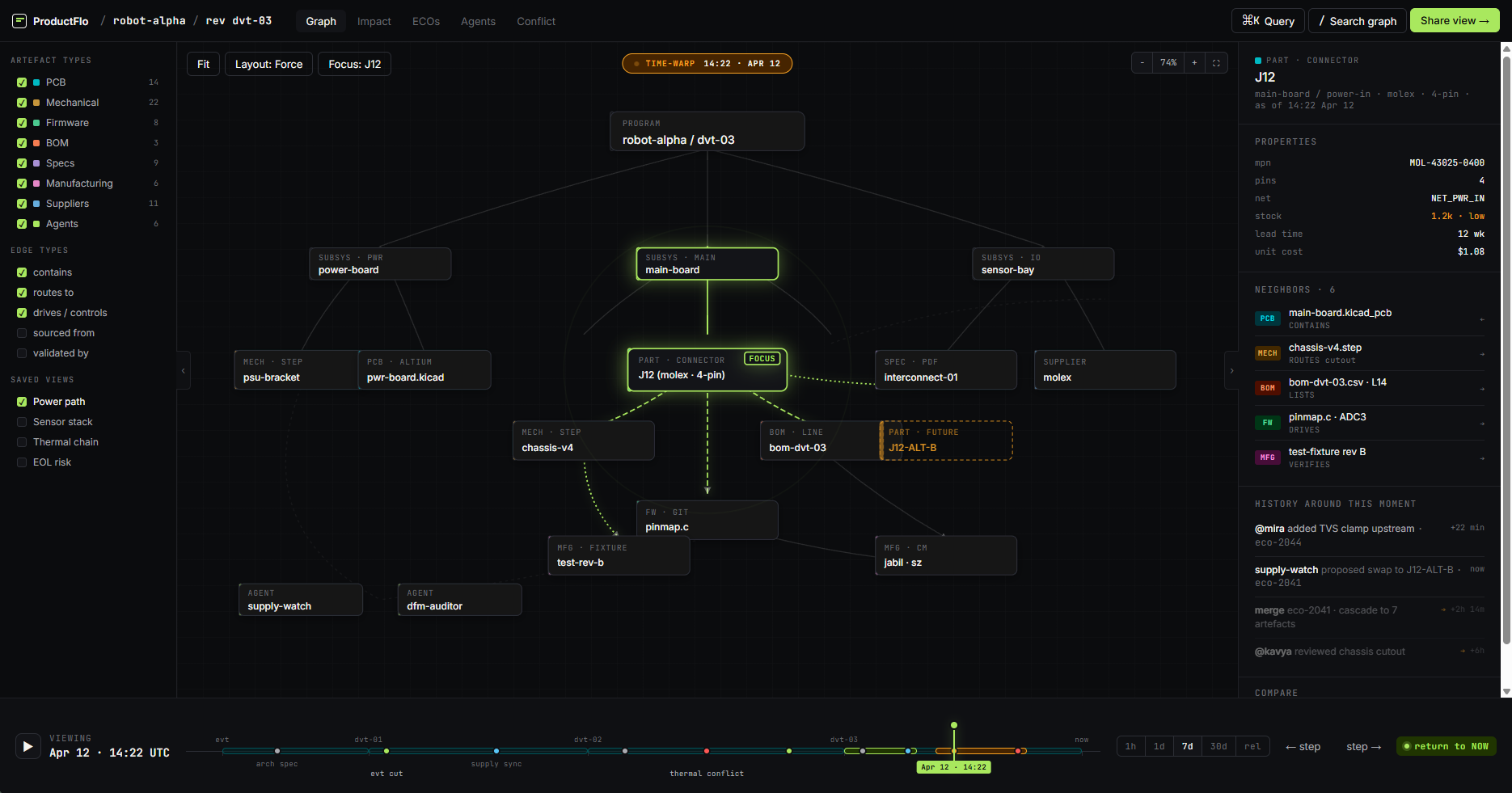
productflo.io / robot-alpha / graphLIVE
The graph — every part, every net, every dependency across mechanical, electrical, firmware, and manufacturing. Click any node to see everything it touches.
One orchestration layer that connects every engineering tool, artefact, and agent.
ProductFlo turns every source file your team creates into shared context, and gives humans and agents one governed way to understand, review and validate changes across disciplines.
01 · ENGINEERING SOFTWARE
In-host plugins
ProductFlo appears inside the tools engineers already use and keeps their source artefacts in the loop.
Altium
SolidWorks
GitHub
KiCad
Onshape
Onshape document panel is live. Altium, SolidWorks, GitHub, and KiCad integrations are in development.
02 · SOURCE UNDERSTANDING
Artefact parsers
Native engineering files become typed, queryable objects instead of opaque files in a vault.
MCAD
ECAD
Firmware
BOM
Docs
Source code
03 · DEVELOPER ACCESS
SDK + API + MCP
Connect internal systems, automate workflows, and build on the same governed product context.
API and SDK
Agent MCP
Webhooks
Scoped tokens
Custom connectors
INGEST + SYNC
PRODUCTFLO CORE
Typed product graph
Parts, assemblies, nets, pins, requirements, BOM lines, firmware symbols, and decisions become one versioned source of engineering context.
PARSEDTYPEDLINKEDVERSIONED
CONTEXT + TOOLS
04 · REASON
Built-in agents
ProductFlo agents read the graph, run scoped checks, and propose changes for human review.
Impact analyzer
Pin-map guard
BOM reconcile
Supply watch
Compliance sentinel
05 · EXTEND
MCP gateway
Give external agents governed graph context and scoped tools without handing them unrestricted source access.
MCP SERVER
Context + tools
External agents
Engineering copilots
Custom automation
PROPOSE + REVIEW
06 · GOVERNED OUTPUT
Decisions return to the workflow.
SYNC BACK THROUGH PLUGIN OR API
Impact analysis
Cross-discipline blast radius before a change is approved.
Engineering Design review
A proposed change with evidence, rationale, and owners.
Governed Change Orders
Human approval, routing, and a signed change record.
Audit evidence
A versioned trail of what changed, why, and by whom.
How it works
A graph index, a set of agents, and a review gate.
ProductFlo reads your existing tools in place, builds a typed graph of every part and connection, runs agents that draft safe changes, and gates every commit through the humans who should see it.
01
GRAPH
One typed model
Parts · nets · signals · tolerances · suppliers · revs — one queryable graph across MECH / ELE / FW / MFG.
02
AGENTS
Safe proposers
Scoped agents watch the graph, draft ECOs, and write diffs — never commits. They propose, humans approve.
03
REVIEW
ECOs as diffs
Every change is a reviewable, reversible diff with the right reviewers auto-selected by discipline & ownership.
04
GOVERNED
Proposals, not pushes
Approved ECOs are packaged as reviewable proposals for each target system. Native write-back is in development — ProductFlo never pushes changes silently.
The surface a designer sees in the dashboard is exactly the surface an agent hits in code — typed, scoped, diffable, audit-logged.
→Typed tool-calls over JSON-LD — not files.
→Every mutation returns a reviewable diff.
→Role-scoped credentials per agent, per product, per rev.
→Webhooks on every state change.
→MCP-native — wire any model in, out of the box.
Agents
Ships with the agents every hardware team needs.
All agents are scoped, auditable, dry-run-capable, and propose diffs; never commits. Bring your own models, or use ours.
REV-NARRATOR
Rev summary author
Turns every rev into a human-readable changelog. Groups ECOs by theme, writes release notes, drafts MRB memos.
TRIGGER · rev-cut
IMPACT-ANALYZER
Cross-discipline impact
Answers "what breaks if…" in seconds. Powers the impact view and gives every ECO its blast-radius estimate.
TRIGGER · query · eco-draft
DESIGN-FOR-X
Design-for-X linter
DfM · DfA · DfT · DfR — drafted by the agents that own each concern, reviewed by you.
TRIGGER · design-save · eco-draft
BOM-RECONCILE
BOM & AVL reconciler
Keeps the design BOM, the mfg BOM, and the PLM BOM in sync. Flags drift, proposes AVL additions, routes to procurement.
TRIGGER · bom-save · nightly
THERMAL-CHECK
Thermal envelope linter
Cross-checks FW duty cycles against heat-sink geometry and rail current budgets. Flags envelope violations at diff time.
TRIGGER · fw-commit · eco-review
PINMAP-GUARD
Pin-map conflict detector
Validates every pin assignment across schematic, firmware, and mechanical connector pinouts. Single source of pin truth.
TRIGGER · schematic-save · pr-open
CERT-SENTINEL
Compliance & cert watcher
Knows which artefact changes re-open FCC / UL / 510(k) / IEC cert gates. Flags the cost before the merge, not after.
TRIGGER · eco-review
SUPPLY-WATCH
Supply & lifecycle monitor
Watches supplier feeds for EOL, lead-time, and MOQ changes. Drafts alternates keyed to your approved vendor list.
TRIGGER · supplier feed · daily
CUSTOM
Bring your own agent
Write a custom agent in 20 lines. Scoped tokens, typed tool-calls, dry-run mode, audit log — all out of the box.
TRIGGER · any webhook · any model
In-host plugins
Lives where your engineers already work.
No migration. No new tool to learn. No rip-and-replace. ProductFlo shows up as a task pane in SolidWorks, a bot on GitHub, and a panel in Onshape — serving the same live graph. The Altium side panel is in development for 2026.
API / SDK / MCPAVAILABLE
Any outside connection
Connect any tool and AI agent with our REST API/SDK/MCP. Define a schema, map fields to graph nodes, and ProductFlo keeps it in sync with webhooks or polling.
Docs available
GITHUBIN DEV
PR review checks
Firmware PRs that touch a pin are cross-checked against the schematic and reported as check runs with file-and-line annotations. Your branch protection decides what blocks — ProductFlo advises; it never blocks a merge.
In development
SOLIDWORKSIN DEV
Assembly task pane
See electrical and firmware dependencies on every part in your assembly. Clash-check against the live PCB outline. ECOs are proposed in ProductFlo and approved by you — in-place commit is in development.
In development
ONSHAPEAVAILABLE
Document panel
Surface cross-discipline dependencies inside Onshape documents. See which electrical and firmware artefacts depend on every part and assembly.
v0.1
FUSION 360AVAILABLE
Cloud connector
Link Fusion 360 components to the product graph via the cloud connector. Mechanical changes surface as governed impact proposals — the in-host design workspace add-in is in development.
v0.1
KICADAVAILABLE
Schematic & layout flow
KiCad projects flow into the ProductFlo graph — net changes, footprint swaps, and BOM updates. Anything flowing back is a human-gated proposal, never a silent sync.
v0.1
ALTIUMIN DEV
Schematic side panel
Shows ownership, cross-discipline impact, and open ECOs on whatever the engineer clicks. Propose a part swap without leaving the editor.
Coming 2026
CADENCEIN DEV
OrCAD & Allegro bridge
Import schematics and board layouts from Cadence tools into the unified graph. Pin-map validation and net-level impact analysis included.
Coming 2026
ZEPHYR RTOSIN DEV
Devicetree & Kconfig sync
Map Zephyr devicetree bindings to the hardware graph. Pin reassignments and peripheral changes are validated against the schematic before merge.
Coming 2026
WINDCHILLIN DEV
PLM change drafts
Planned: Windchill part structures and BOMs flow into the live graph, and ECOs authored in ProductFlo will draft Windchill change notices for your approval — nothing sent without a human.
Coming 2026
ARENAIN DEV
BOM & change order bridge
Planned: sync Arena BOMs, approved manufacturer lists, and change orders. ProductFlo ECOs will draft Arena ECOs with matched line items.
Coming 2026
SAP / ERPIN DEV
Manufacturing BOM sync
Bridge the engineering BOM to SAP material masters and production BOMs. Cost and lead-time data flows back into impact analysis.
Coming 2026
CREOIN DEV
In-host plugin
ProductFlo inside PTC Creo — cross-discipline dependencies on every part and assembly.
Coming 2026
INVENTORIN DEV
In-host plugin
ProductFlo inside Autodesk Inventor — cross-discipline dependencies on every part and assembly.
Hardware Engineering teams are already shipping faster.
"We cut our ECO cycle time by 74% in the first month. Our engineers stopped arguing about changes in each revision and started arguing about the robot again."
Directional estimate based entirely on the assumptions you enter. Recovered capacity is not the same as audited savings or guaranteed financial performance.
Design partner product
Start with a 30-day pilot on one active product.
We're in controlled rollout through 2026. Fixed scope. Fixed fee. Named solutions engineer. You see the graph on your own BOM in week one.
Pilot
$8k/ 30 days
One product. Three artefact sources. Joint success metrics. Fixed.
The questions every VP Eng asks us on the first call.
Do we need to rip out our PLM?+
No. ProductFlo sits on top of your existing tools — Altium, SolidWorks, Git, your BOM system, your PLM. We index in place and build the graph from the artefacts you already have. Turn us off any day with zero lock-in.
How is this different from Windchill, Teamcenter, or Arena?+
Those are file vaults. They store artefacts. ProductFlo is a graph — it understands what's inside the files and how they relate. And it's built for agents, not just humans. We're a layer above PLM, not a replacement for it (yet).
What about IP and security?+
SOC 2 Type I today. ISO 27001 mid-2026. HIPAA BAA available. Self-host for ITAR/EAR. Your artefacts never leave your environment in self-host mode. Every agent call is audit-logged with the prompt, the model, and the diff produced.
How do agents not break things?+
Agents only propose — they never commit. Every output is a reviewable diff, scoped by discipline, routed to the right owners. Dry-run mode is on by default. Scoped tokens limit blast radius to one product or one rev.
Which models do you use?+
Frontier models today (Claude, GPT-5, Gemini) for the agents that benefit from long context. Smaller, local models for the ones that run on every commit. Bring-your-own-model is supported end-to-end — we're MCP-native.
How fast is a pilot?+
First value inside an hour. Full graph on one product in a week. Agents running in production by week three. We bring a named solutions engineer to every pilot — you don't configure anything alone.
What verticals are you optimized for?+
Robotics, medical devices, consumer electronics, aerospace & defense, automotive/EV. Anywhere mechanical + electrical + firmware + manufacturing all ship as one product.
What do you need from us to start?+
Read-only access to one active product's artefacts: your CAD vault, your PCB repo, your BOM sheet, your firmware repo. We build the graph, then you decide what to turn on.
Ready when you are
See ProductFlo run on your own product.
30-minute scoping call. We map your artefact sources, pick one active product, and show you the graph — live — by the end of the week.